
Introducing the FPOSoft Vocabulary
Introducing the FPOSoft Taxonomy — a curated vocabulary for agriculture, value chains, markets, and enterprise development. Learn how it enables AI-ready data, knowledge graphs, and intelligent business planning.
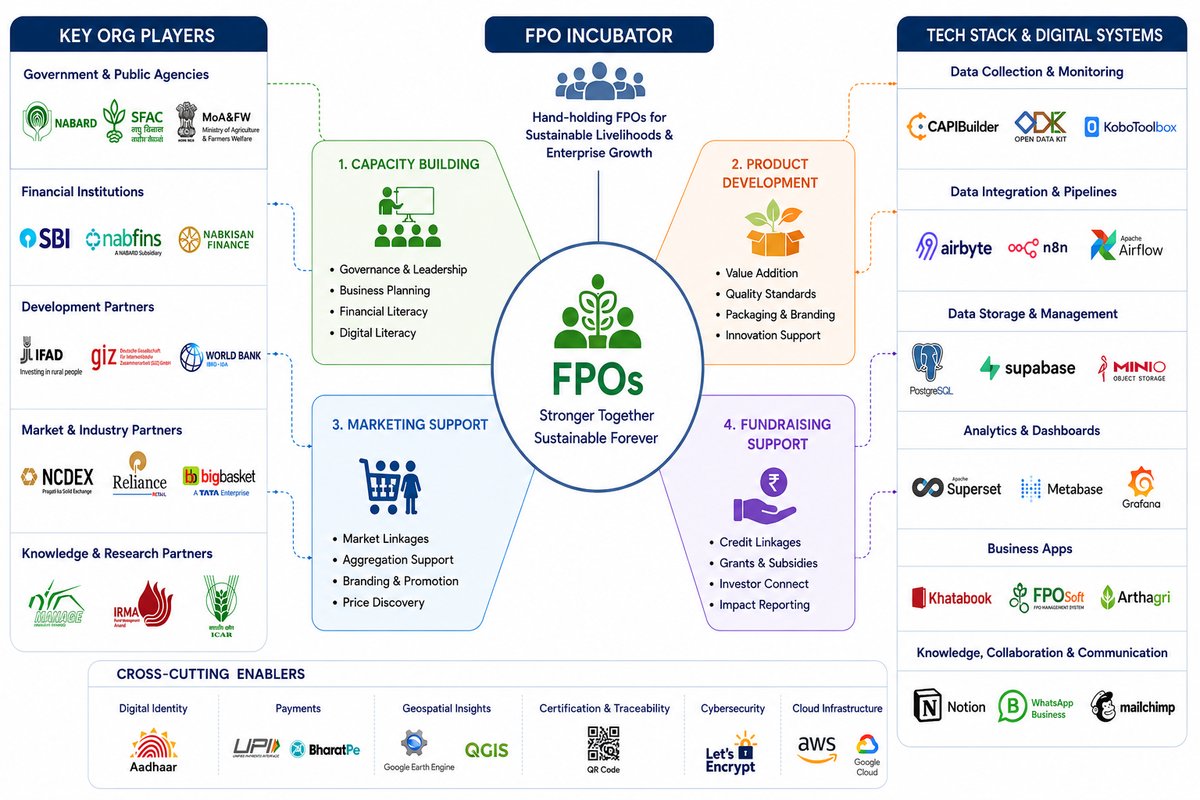
Farmer Producer Organizations (FPOs) aggregate agricultural inputs and market produce on behalf of their member farmers. They carry out these activities through numerous physical and digital channels. FPO incubators provide hands-on technical assistance to FPOs in four key areas - capacity building, product development, marketing, and fundraising support. To deliver these incubation services, FPO incubators connect with a range of digital systems (Figure 1).
Figure 1: Connected digital systems used by FPO incubators
 ### From Baseline Data to Business Plans
Data collection applications like Open Data Kit, CAPIBuilder, and SurveyCTO provide baseline data for quantities and pricing benchmarks for inputs and produce for different cropping seasons. In 2024, FPOSoft brought out a baseline survey toolkit that NABARD piloted in Odisha and Telangana as part of the 'Formation and Promotion of 10,000 Farmer Producer Organizations'. Three-year projection is derived from the annual input and production estimates for the FPOs.
FPO business plans are a three-year projection generated based on these annual estimates. During 2024-25, FPOSoft was using a pre-defined extraction, transformation, and load (ETL) pipeline to get the baseline data from CAPIBuilder, run the computations, and load the values in MS-Excel and Word formats in business plans. During those years, the implementing agencies supporting the FPOs under the 'Formation and Promotion of 10,000 Farmer Producer Organizations', prescribed a standard business plan template that was applicable to most FPOs. A few FPOs started raising debt financing. Those public sector banks and non-banking finance company often had additional sections and requirements in their business plan or detailed project report (DPR) templates.
What is Taxonomy
A taxonomy defines concepts, organizes them into hierarchical categories, identifies related concepts, and may also describe the scope in which each concept applies. Organizations can therefore use a taxonomy consistently across business processes such as product design, marketing, customer service, and analytics. It standardizes the use of concepts across business units and information systems.
Taxonomy in Preparation of DPR
FPO incubators supporting the FPOs in raising capital will increasingly need to generate business plans and Detailed Project Reports (DPRs) in the formats prescribed by different financial institutions. In a generative AI environment, the context supplied to the large language model includes the summarized baseline data, the target DPR template, and a carefully designed meta prompt. Beyond supplying the context, a domain taxonomy provides the semantic structure that enables the AI system to interpret and connect information consistently across datasets, templates, and institutional requirements.
The taxonomy standardizes concepts such as crops, value chains, products, processing activities, infrastructure, machinery, markets, financial products, risks, certifications, and government schemes. Rather than relying on keyword matching, an AI agent can use these standardized concepts to identify relationships between baseline survey data, production estimates, financial assumptions, and the sections of the DPR that require them. For example, a baseline survey indicating that an FPO cultivates turmeric can be connected through the taxonomy to turmeric processing, drying infrastructure, quality certification requirements, potential buyers, working capital norms, and relevant government support schemes.
When the taxonomy is represented as a knowledge graph, the AI agent can perform multi-step reasoning using GraphRAG. Instead of retrieving isolated text passages, it traverses the relationships between concepts—linking crops to commodities, commodities to products, products to value chains, value chains to markets, financial institutions to their DPR requirements, and infrastructure to investment costs. This connected reasoning enables the AI agent to prepare business plans that are more accurate, context-aware, and explainable. As financial institutions revise their DPR templates or introduce sector-specific requirements, the knowledge graph allows the AI system to retrieve the appropriate context dynamically without redesigning the entire prompting workflow.
In this architecture, the taxonomy becomes the common semantic layer connecting data collection systems, business planning software, document templates, and generative AI. It ensures that the same concepts are interpreted consistently throughout the incubation process, reduces manual mapping between multiple systems, and enables FPO incubators to generate institution-specific DPRs at scale while maintaining consistency and traceability.
Introducing FPOSoft Vocabulary
FPOSoft supports Farmer Producer Organizations (FPOs) and small and medium enterprises by generating business plans, market intelligence, and enterprise development insights.
FPOSoft vocabularies standardize concepts related to agriculture, value chains, commodities, financial services, markets, and enterprise development. The vocabulary is a selection of concepts from FAO AGROVOC, and it will evolve based on the implementation by the FPO incubators. Take a look at the FPOSoft Vocabulary: https://vocab.socialwell.net/fposoft/en.